Skip to content
Cover of Head First Java: A Learner's Guide to Real-World Programming by Kathy Sierra, Bert Bates, Trisha Gee
#1

Head First Java: A Learner's Guide to Real-World Programming, 3rd Edition

Best for: First-time programmers who want an engaging, visual approach

A visually driven, puzzle-and-story approach to learning Java that trades dry syntax dumps for exercises, illustrations, and 'brain-friendly' explanations. This third edition brings the material up through Java 17 and adds coverage of lambdas, streams, and modern collections. Best suited to readers who find traditional programming textbooks tough to stay engaged with.

Cover of Java: The Complete Reference by Herbert Schildt, Danny Coward
#2

Java: The Complete Reference, 13th Edition

Best for: Beginners who want one thorough reference that grows with them

A comprehensive, encyclopedic tour of the Java language and core API, updated for Java SE 21 with features like pattern matching in switch and virtual threads. It works well as both a structured first read and a reference to keep on the shelf afterward. Newcomers should expect a denser, more traditional textbook style than the Head First series.

Cover of Think Java: How to Think Like a Computer Scientist by Allen B. Downey, Chris Mayfield
#3

Think Java: How to Think Like a Computer Scientist, 2nd Edition

Best for: Students and self-learners who want a structured, course-like intro

A concise, classroom-tested introduction that treats Java as a vehicle for learning to think like a programmer, not just memorize syntax. It's built from real college and AP Computer Science A courses, so each short chapter maps to a week of study and builds steadily toward object-oriented design. A good fit for readers who prefer a slower, concept-first pace over a big reference-style book.

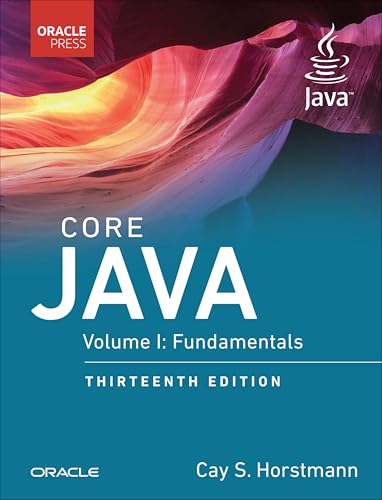
Cover of Core Java, Volume I: Fundamentals by Cay S. Horstmann
#4

Core Java, Volume I: Fundamentals, 13th Edition

Best for: Motivated beginners who want depth without marketing fluff

A rigorous, example-heavy walk through Java fundamentals from a long-time trainer and well-known Java author, updated to reflect Java 21. It leans more formal than the Head First series but explains the 'why' behind language features rather than just listing syntax, making it a strong second book after a lighter introduction. Volume II picks up advanced topics once you finish this one.

Cover of Murach's Java Programming by Joel Murach
#5

Murach's Java Programming, 6th Edition

Best for: Absolute beginners who like a self-paced, guided workbook style

A paced, exercise-driven textbook aimed squarely at people with zero programming background, built around Murach's signature 'paired pages' format that pairs explanation with runnable code side by side. It covers both NetBeans and Eclipse workflows and builds toward small complete applications rather than isolated snippets. Its classroom pedigree makes it a solid choice for self-study or a first course.

Cover of Java: A Beginner's Guide by Herbert Schildt
#6

Java: A Beginner's Guide, 9th Edition

Best for: Readers who want Schildt's teaching style in a lighter package

A step-by-step, no-prior-experience-assumed guide from the author of Java: The Complete Reference, walking readers from installing a JDK through writing, compiling, and running their first programs. It's updated for Java SE 17 and gradually introduces multithreading, generics, lambdas, and Swing after covering the core language. A shorter, friendlier companion to Schildt's much bigger reference book.

Cover of Java For Dummies by Barry Burd
#7

Java For Dummies, 8th Edition

Best for: Total beginners who want the gentlest possible on-ramp

A friendly, jargon-light entry point that assumes nothing and explains Java concepts through plain-language analogies before showing the code. Written by a longtime computer science professor, it covers building classes and objects, then moves into newer features added through Java 17. Its casual tone makes it a comfortable starting point for readers intimidated by denser textbooks.

Cover of Beginning Java Programming: The Object-Oriented Approach by Bart Baesens, Aimée Backiel, Seppe vanden Broucke
#8

Beginning Java Programming: The Object-Oriented Approach

Best for: Career-changers and students wanting a business-oriented intro

Developed from a university course the authors taught, this book builds up object-oriented thinking gradually alongside Java syntax, using an IDE-based workflow and exercises based on realistic business scenarios. Its final chapters use case studies that tie multiple concepts together into small working systems. A good fit for readers who want an academic, business-context flavor rather than a hobbyist tone.