Skip to content
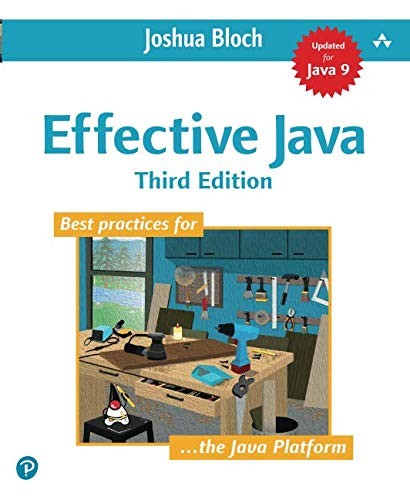
Cover of Effective Java by Joshua Bloch
#1

Effective Java, 3rd Edition

Best for: Java developers who want to write more idiomatic, defensible code

Joshua Bloch's item-by-item guide distills decades of API design experience from his time leading Java platform work at Sun and Google into concrete, justified rules covering generics, enums, lambdas, streams, and object lifecycle. The 3rd edition folds in Java 7 through 9 features while keeping the same terse, example-driven format. It works both as a cover-to-cover read once you already know core Java and as a reference to consult when a specific design question comes up.

Cover of Modern Java in Action: Lambdas, Streams, Functional and Reactive Programming by Raoul-Gabriel Urma, Mario Fusco, Alan Mycroft
#2

Modern Java in Action: Lambdas, Streams, Functional and Reactive Programming

Best for: Developers moving to functional-style, stream-based Java

This is the book that reframes how you think about Java once lambdas and streams enter the picture. It walks from basic lambda syntax through the Streams API, then into more advanced functional patterns like Optional and CompletableFuture, with a light touch on reactive programming and the module system. Written for developers who already write Java daily but still reach for old-style loops and mutation out of habit.

Cover of Core Java, Volume II—Advanced Features by Cay S. Horstmann
#3

Core Java, Volume II—Advanced Features, 12th Edition

Best for: Developers who want a deep reference beyond core syntax

The companion to Horstmann's Volume I, this book picks up once you know core syntax and moves into streams, XML, networking, databases, internationalization, and security APIs. It's organized as a reference you dip into chapter by chapter rather than read cover to cover. A solid pick for developers who want authoritative, example-heavy coverage of the standard library's less-basic corners.

Cover of Java by Comparison: Become a Java Craftsman in 70 Examples by Simon Harrer, Jörg Lenhard, Linus Dietz
#4

Java by Comparison: Become a Java Craftsman in 70 Examples

Best for: Developers who want tighter, more professional-looking code

A short, focused book built entirely around side-by-side before-and-after code examples — each one taking a common but flawed snippet and showing exactly how and why to improve it. It covers naming, exception handling, testing, and general code hygiene rather than any single Java feature. Best suited to developers who already know the syntax and now want to write code a teammate would actually enjoy reviewing.

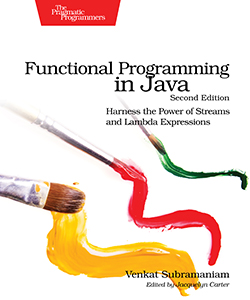
Cover of Functional Programming in Java: Harness the Power of Streams and Lambda Expressions by Venkat Subramaniam
#5

Functional Programming in Java: Harness the Power of Streams and Lambda Expressions, 2nd Edition

Best for: Developers wanting a practical, exercise-driven functional-Java primer

A hands-on introduction to thinking functionally in Java, built around small, practical exercises rather than theory. It covers lambdas, method references, and the Streams API, then goes further into error handling and refactoring imperative code into functional style. Good for developers who understand streams syntactically but still write imperative code out of reflex.

Cover of The Well-Grounded Java Developer by Benjamin J. Evans, Martijn Verburg, Jason Clark
#6

The Well-Grounded Java Developer, 2nd Edition

Best for: Developers catching up on modern Java and its ecosystem

Written explicitly for developers past the beginner stage, this book brings you up to speed on everything that changed in Java from version 8 onward — modules, newer language features, build tooling with Maven and Gradle, and a broad tour of the wider JVM ecosystem including Kotlin. It's intentionally wide-ranging rather than narrowly focused, making it a good way to fill gaps in a developer's mental map of modern Java.

Cover of JUnit in Action by Catalin Tudose
#7

JUnit in Action, 3rd Edition

Best for: Developers who want to write real, maintainable test suites

A practical, thorough guide to testing Java code well, built around JUnit 5's newer architecture — nested and parameterized tests, dependency injection, and mocking with Mockito. It also covers testing in context: databases, REST APIs, and build-pipeline integration. A natural next step for developers who know how to write a basic @Test method but haven't yet learned to design a real test suite.