Skip to content
Cover of Design Patterns: Elements of Reusable Object-Oriented Software by Erich Gamma, Richard Helm, Ralph Johnson, John Vlissides
#1

Design Patterns: Elements of Reusable Object-Oriented Software

Best for: Developers who want the original vocabulary behind object-oriented design patterns

Written by the 'Gang of Four,' this is the book that gave the industry a shared vocabulary of 23 object-oriented patterns, from Singleton to Visitor. Its examples are in C++ and Smalltalk rather than Java, but nearly every Java framework and API you use today (java.util.Iterator, Spring's factories, decorators in java.io) is built on the vocabulary this book introduced. Best treated as a reference to dip into once you already have some OOP experience, not a first read.

Cover of Head First Design Patterns: Building Extensible and Maintainable Object-Oriented Software by Eric Freeman, Elisabeth Robson
#2

Head First Design Patterns: Building Extensible and Maintainable Object-Oriented Software, 2nd Edition

Best for: Developers who want design patterns taught through examples rather than theory

A friendly, visually driven walkthrough of the same core design patterns the GoF catalog defined, but explained through worked scenarios, diagrams, and running Java code rather than dense prose. The second edition updates its examples for modern Java (lambdas, streams) and is generally considered the easiest on-ramp into design patterns for working developers. Good as a companion or a more approachable alternative to the original GoF book.

Cover of Clean Code: A Handbook of Agile Software Craftsmanship by Robert C. Martin
#3

Clean Code: A Handbook of Agile Software Craftsmanship

Best for: Developers who want cleaner, more maintainable code at the function and class level

Robert Martin's argument for treating naming, functions, formatting, and error handling as first-class design decisions, illustrated almost entirely with Java code and Java-centric refactoring case studies. It's opinionated and sometimes contested in the community, but it remains one of the most widely referenced books on day-to-day code quality among Java teams. Best read after you already have some professional Java experience so you can weigh its advice critically rather than dogmatically.

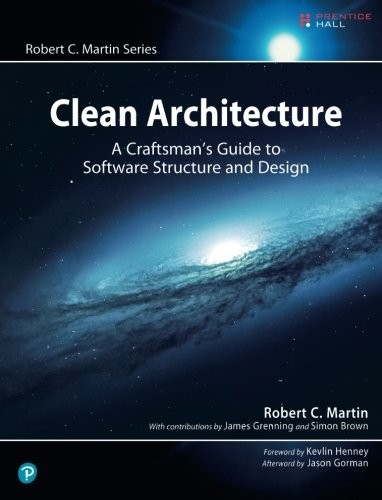
Cover of Clean Architecture: A Craftsman's Guide to Software Structure and Design by Robert C. Martin
#4

Clean Architecture: A Craftsman's Guide to Software Structure and Design

Best for: Developers and architects designing the high-level structure of an application

Martin's follow-up to Clean Code zooms out from individual methods to whole-system structure, arguing for dependency rules that keep business logic independent of frameworks, databases, and UI. It's language-agnostic in its diagrams but draws its worked examples largely from the Java/OOP world its author comes from, and its layering approach has become a common reference point in Spring Boot project structuring. Assumes you already understand basic design principles like SOLID.

Cover of Patterns of Enterprise Application Architecture by Martin Fowler
#5

Patterns of Enterprise Application Architecture

Best for: Backend developers designing the data and service layers of enterprise systems

A catalog of over 40 recurring solutions for structuring data-heavy business applications — layering, object-relational mapping strategies, session state, and concurrency patterns like Optimistic Offline Lock. Code samples are given in both Java and C#, and many of its patterns (Data Mapper, Unit of Work, Repository) are directly visible in how Java ORMs like Hibernate and JPA are shaped. Dense and reference-like; most useful once you're already building multi-layered server-side systems.

Cover of Domain-Driven Design: Tackling Complexity in the Heart of Software by Eric Evans
#6

Domain-Driven Design: Tackling Complexity in the Heart of Software

Best for: Developers and architects tackling complex business domains, not just CRUD apps

Known in the community as 'the Blue Book,' this is the source text for domain-driven design: ubiquitous language, bounded contexts, aggregates, entities versus value objects, and modeling software around a shared understanding of the business domain. Its code samples are Java, and DDD's vocabulary now underlies how many Java teams structure Spring or Jakarta EE applications around domain modules rather than technical layers. It's conceptually dense and repays a second read once you've tried applying it.

Cover of Refactoring: Improving the Design of Existing Code by Martin Fowler, Kent Beck
#7

Refactoring: Improving the Design of Existing Code

Best for: Java developers who want a systematic, example-driven approach to improving existing code

This is the 1st edition, whose worked examples and refactoring catalog are written in Java — note that Fowler's 2018 2nd edition rewrote all the examples in JavaScript, so this original printing is the one to pick for a Java-specific read. It walks through named, small, behavior-preserving transformations (Extract Method, Replace Conditional with Polymorphism, etc.) using a running Java example, teaching you to recognize 'code smells' and fix them incrementally.

Cover of Growing Object-Oriented Software, Guided by Tests by Steve Freeman, Nat Pryce
#8

Growing Object-Oriented Software, Guided by Tests

Best for: Developers who want to see TDD and OO design practiced together on a real Java codebase

A practical, project-length walkthrough of test-driven development done at the object-design level, built end-to-end in Java using JUnit and the authors' own mocking library (a forerunner of jMock/Mockito-style thinking). It shows how outside-in TDD and careful attention to object collaboration naturally lead to better-decomposed, more testable designs, rather than treating testing and design as separate concerns.